Fascias, soffits and guttering
Full replacement UPVC roofline across Flintshire, Deeside, Chester and Wrexham. The old boards come off, the new ones go on, and the roof space keeps the ventilation it needs.
What the roofline actually does
The fascia is the board running along the bottom edge of the roof. It closes off the ends of the rafters and it carries the guttering. The soffit is the board underneath it, bridging the gap between the fascia and the wall. Together they keep weather and wildlife out of the eaves and give the roof its finished line.
It's the part of the roof people look at every day without noticing — until it starts to sag, stain or come loose, at which point the whole house starts to look tired regardless of what condition the roof covering is in.
When roofline needs replacing
Not every tired-looking fascia needs replacing. Green staining and general grime usually come off with a wash. What doesn't come off is a board that's failing.
- Sagging guttering — often the board behind it has lost its grip on the fixings.
- Soft or crumbling timber on older timber fascias, particularly at the corners and behind the gutter.
- Boards that have dropped at one end, or pulled away from the rafter feet.
- Cracked or split UPVC, usually from thermal movement over many years.
- Staining running down the wall beneath the gutter line, which normally means it's been overflowing for some time.
- Birds or wasps getting into the eaves through gaps where the soffit has failed.
If you're not sure which category yours falls into, send a couple of photographs taken from the ground. We'll tell you whether it needs replacing, whether it has years left in it, or whether it just needs a clean. We'd rather tell you it's fine than sell you work you don't need.
Full replacement board, not capping
This is the single most useful thing to understand before you gather quotations, because it explains most of the price difference between them.
There are two ways to fit a UPVC roofline. The quicker way is to leave the existing board in place and fit a thin capping board over the top of it. The other way is to strip the old board off completely and fit a new full replacement fascia — typically 18mm — to the rafter feet.
Capping is faster and cheaper, and on the day it's finished the two look much the same. The difference is that capping leaves whatever was there before still in place and out of sight. If that board was sound, that may be acceptable. If it was soft or rotting, it carries on rotting behind the new plastic where nobody can see it.
“Is the old board coming off, or are you capping over it?” — ask every roofer who quotes you. The answers will explain the price difference.
LSE Roofing fits full replacement board as standard. A thicker board is also rigid enough to carry the guttering properly and hold a straight line over time, which is what stops a roofline looking wavy a few years down the road.
Ventilation — the part nobody sees
A roof space needs airflow. Without it, moisture that rises from inside the house has nowhere to go, and you get condensation forming on the underside of the roof, damp timbers, and eventually mould.
Plenty of older properties have that airflow provided by vents built into the soffit. If a solid soffit is fitted in their place and nothing replaces that ventilation, the roof space ends up sealed. The roofline looks smart and the problem develops quietly in the loft.
There are two straightforward ways to deal with it: vented soffit, or over-fascia vents fitted along the eaves. Over-fascia vents keep the airflow without breaking up the clean line of the new soffit, which is often the better-looking option. Which one is right depends on the roof.
Either way, ventilation should be part of the conversation before the job starts. If it hasn't come up in a quotation you've been given, it's worth asking about.
What we fit
| Fascia | 18mm full replacement board. White, black, anthracite grey, and woodgrain finishes including rosewood and golden oak. |
|---|---|
| Soffit | Hollow soffit for a matched shadow line, or flat soffit board. Vented options where the roof needs ventilation at the soffit. |
| Ventilation | Vented soffit or over-fascia vents, specified to suit the roof. |
| Guttering | Half-round and square-line guttering and downpipes, set to the correct fall so water goes where it should. |
| Bargeboards | Gable-end bargeboards replaced to match the rest of the roofline. |
| Cladding | UPVC cladding to gable ends and dormers where required. |
| Suppliers | Materials supplied through Future Building Plastics and our regular trade merchants. |
How the job runs
- We come and look. Not from the pavement — we get up to it, or get eyes on it properly, and check the state of the boards and the guttering fall.
- You get a written quotation. Colour, material, board type, ventilation, guttering, scaffolding and waste removal all itemised, so you can see what you're buying and compare it fairly with anything else you've been quoted.
- Access is arranged. Where scaffolding is needed we book it in, usually with GFL Scaffolding, and it's priced separately on the quotation rather than buried in the total.
- The old roofline comes off. Fascia, soffit, guttering and downpipes stripped and taken away.
- New roofline goes on. Boards fitted, ventilation installed, guttering set to fall and downpipes connected.
- Site cleared. Old material removed, gutters checked for flow, and the ground left as we found it.
What affects the price
We don't publish a per-metre rate, because a figure like that tells you very little until someone has looked at the property. What moves the price is:
- The total run of roofline — front, back, and both gables adds up quickly.
- Property height and whether it's a bungalow, a house or has a dormer.
- Whether scaffolding is required, or whether the job can be done safely off ladders or a tower.
- How many corners, returns, porches and extensions are involved — detail costs more than straight runs.
- Colour and board specification.
- Whether bargeboards, cladding or dry verge are included at the same time.
- What's found once the old boards come off.
Doing the whole property at once is almost always better value than doing one elevation now and another next year, because the access cost is the same either way.
If you're having scaffolding up for roofline work anyway, it's the right moment to deal with anything else at that level — dry verge to the gables, chimney or lead work, or a repair you've been putting off. You only pay for the access once.
Wrexham — dated brown UPVC to anthracite in two days.
Full replacement roofline with over-fascia vents and dry verge to both gables, on a property where extensions on both sides ruled out ladder access.
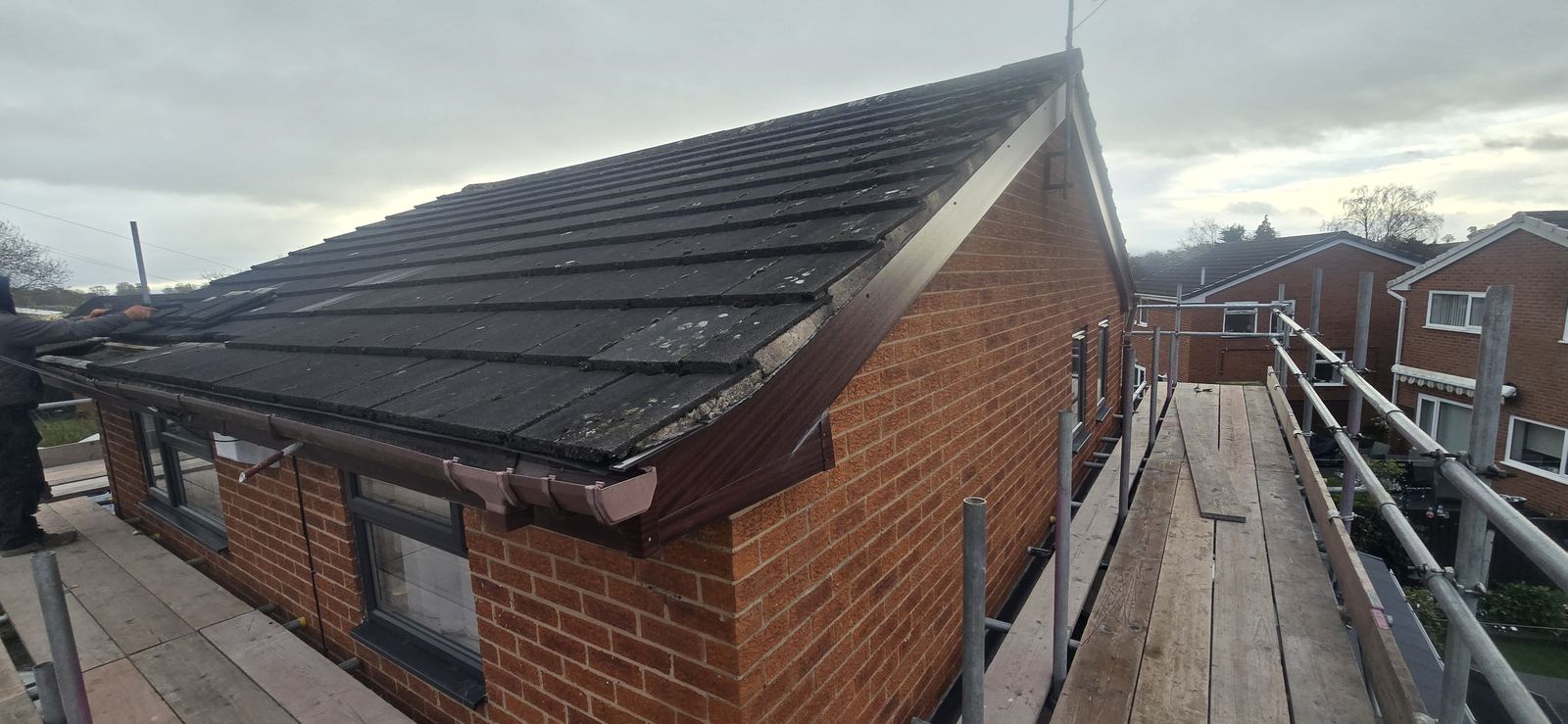 Before
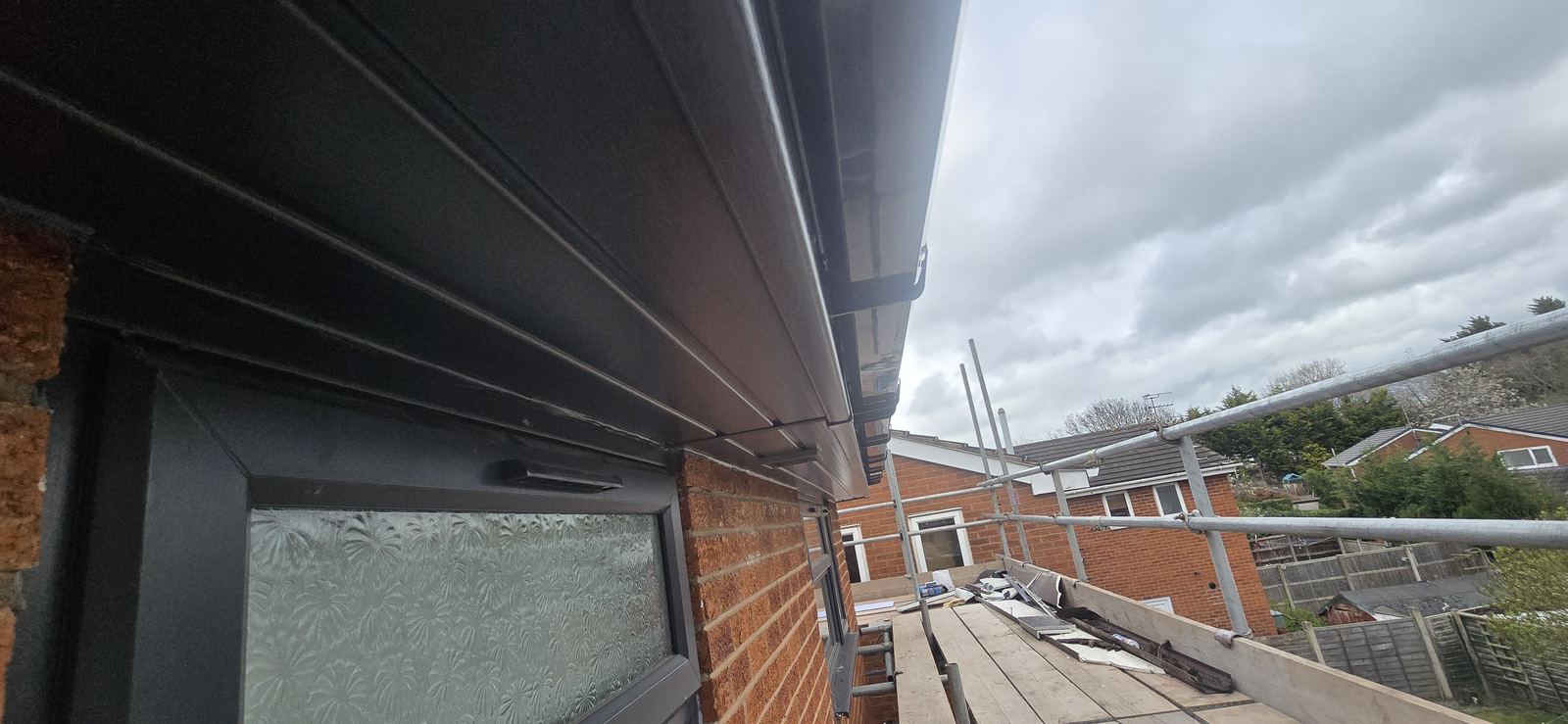 After
After
What people ask about roofline work.
How do I know if my fascias need replacing or just cleaning?+
Green staining and grime usually wash off. What doesn't wash off is a board that's gone soft, cracked, come away from its fixings or dropped at one end. Sagging guttering is often a sign the board behind it has lost its grip. If you're not sure, send a photograph from the ground and we'll tell you honestly which it is.
What's the difference between capping and full replacement?+
A capping board is a thin sheet fitted over the existing board. A full replacement fascia is a thicker board, typically 18mm, fitted after the old one is removed. Capping is quicker and cheaper but leaves whatever is underneath in place. Full replacement costs more, and it's what we fit as standard.
Why does ventilation matter when soffits are replaced?+
Many older soffits have vents in them letting air into the roof space. Fit a solid soffit in their place with nothing to replace that airflow and the roof space can end up sealed, which can lead to condensation and damp timbers. Ventilation should be maintained — either through vented soffit or over-fascia vents at the eaves.
Do I need scaffolding?+
Not always. It depends on the height of the property, the ground conditions, and whether there's safe ladder access along the full run. Extensions, conservatories and sloping ground often rule ladders out. Where scaffolding is needed it's priced separately and shown clearly on the quotation, so you can see exactly what it's costing.
How long does it take?+
For a typical house or bungalow, usually one to three days on site once the scaffold is up. It depends on the size of the property, how many elevations are involved, and what's found once the old boards come off.
What colours can I have?+
White, black, anthracite grey, and a range of woodgrain finishes including rosewood and golden oak. Anthracite has become the most popular choice on properties with grey or anthracite windows, because it ties the whole elevation together.
Can you just replace the guttering?+
Yes, if the fascia behind it is sound. If the board has failed, new guttering fixed to it won't stay put, so we'd tell you that rather than take the job on that basis.
Tired fascias and guttering?
Send a photograph or call and describe what you're seeing. We'll tell you whether it needs replacing or whether it's got years left in it.