
Flat roofing and EPDM
Extensions, dormers, garages and porches re-covered in EPDM rubber over a properly prepared deck. Across Flintshire, Deeside, Chester and Wrexham.
Why old flat roofs fail
Flat roofs have a poor reputation in this country, and most of that reputation was earned by felt roofs laid decades ago in three layers of bitumen. They were never designed to last a lifetime, and they don't.
The usual sequence: the surface goes brittle with age and UV, blisters form where moisture gets trapped, splits open at the joints and upstands, water gets into the deck, the deck softens, and then the whole thing has to come off anyway.
Signs yours is coming to the end:
- Water sitting on the roof for days after rain — the fall has gone, usually because the deck has sagged.
- Blisters, bubbles or splits in the covering.
- Edges lifting away from the trims.
- The surface feeling soft underfoot.
- Staining on the ceiling below, or a smell of damp in the room under it.
EPDM rubber roofing
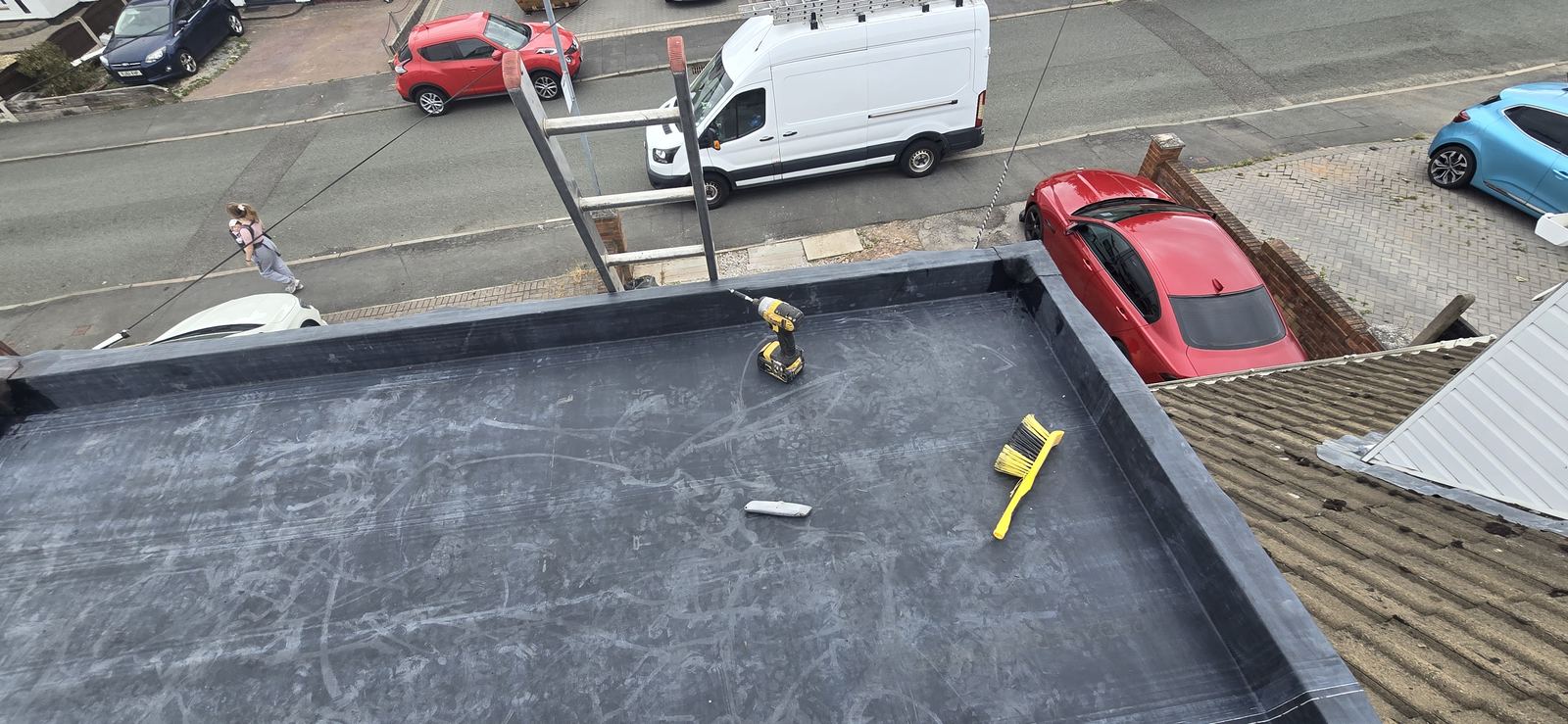
EPDM is a synthetic rubber membrane. The reason we fit it in preference to felt on most jobs comes down to one thing: on the majority of domestic roofs it goes down as a single sheet with no joins.
Joins are where flat roofs leak. Remove the joins across the field of the roof and you've removed most of the failure points. What's left is the detailing at the edges and upstands, which is where the workmanship matters.
It's also flexible, so it moves with the building through temperature changes rather than going brittle and cracking, and it isn't affected by UV in the way bitumen is.
A flat roof doesn't fail in the middle. It fails at the edges, the upstands and the outlets — which is exactly where the care needs to go.
What the job involves
- Strip the old covering back to the deck.
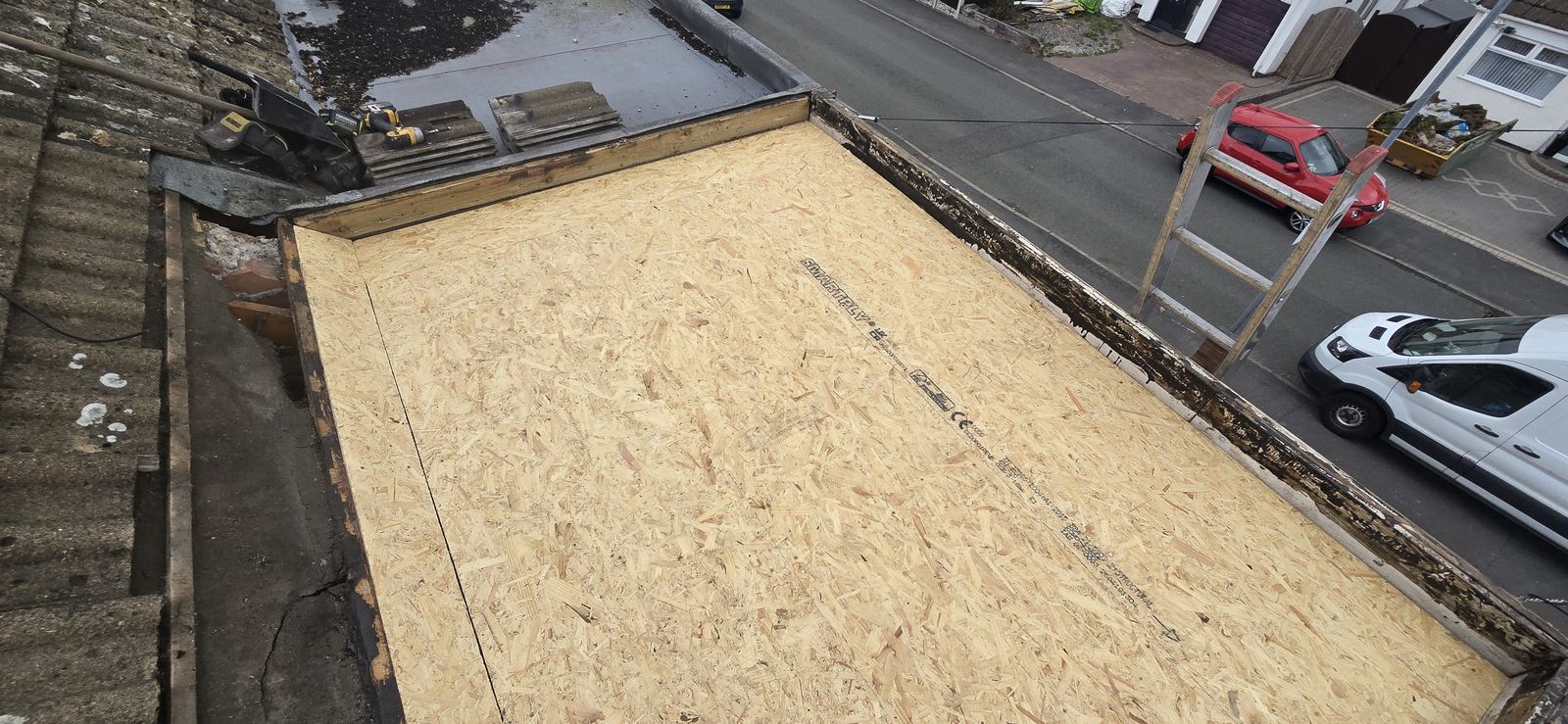
- Assess the deck. Old chipboard and softened timber comes off. There's no point laying a good membrane over a bad deck.
- New deck laid where needed, and firrings fitted to create or restore a proper fall so water runs to the outlet instead of sitting in the middle.
- Trims fitted to the edges — drip trims, edge trims and kerb trims as the roof requires.
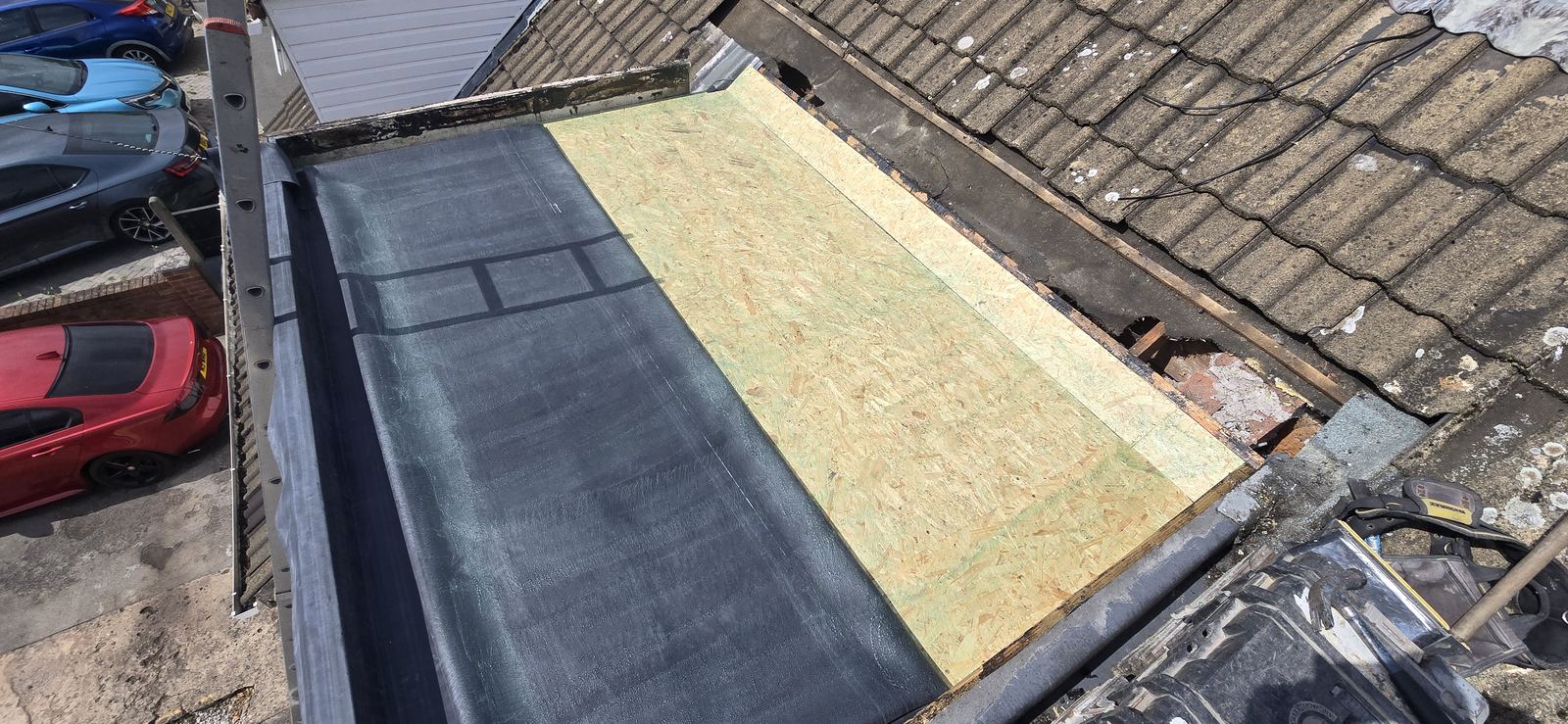
- Membrane laid, relaxed, and bonded down. Upstands dressed against walls and abutments.
- Details finished — corners, outlets, pipe penetrations and the junction with any adjacent pitched roof.
- Site cleared and waste taken away.
If someone quotes you noticeably less than everyone else for a flat roof, the first thing to check is whether they're re-decking or laying over what's already there. A new membrane over a soft deck will look perfect for a year or two and then start moving. Ask the question.
Where we fit it
- Rear and side extension roofs
- Dormer roofs
- Garage roofs
- Porch and canopy roofs
- Bay window tops
- Outbuildings and workshops
What affects the price
- Area of the roof.
- Whether the existing deck can be kept or needs replacing.
- How much detail there is — upstands, abutments, outlets, pipes and corners all take time.
- Access, and whether scaffolding or an edge protection system is needed.
- Waste from the strip.
- Whether new guttering or trims are included.
Repair or re-cover?
A localised split on an otherwise sound roof can sometimes be patched sensibly. But patching a felt roof that's failing generally is throwing money at it — you'll be back within a year or two, and by then the deck may have taken on water.
We'll tell you honestly which situation you're in. If a repair genuinely buys you a few more years, that's a reasonable thing to do.
Deck first, membrane second.
Old covering off, new deck laid to a proper fall, then a single sheet of EPDM dressed over it and finished at the trims.
What people ask about flat roofing.
How long does an EPDM roof last?+
Manufacturers publish expected service lives for their membranes, and they're long — considerably longer than traditional felt. The honest answer for any given roof depends on the deck beneath it, the detailing at the edges and how it's been installed. We'll tell you what the manufacturer states for the material we're using on your job, and pass the manufacturer's own documentation through to you.
Is EPDM better than felt?+
For most domestic flat roofs, yes — largely because it goes down in one sheet with no joins across the field of the roof, and joins are where flat roofs fail. Modern torch-on systems are a genuine improvement on old three-layer felt, but EPDM remains our default recommendation for extensions, garages and dormers.
Can you lay it over my existing roof?+
We'd rather not, and usually won't. If the deck underneath has taken on water or softened, covering it traps the problem instead of solving it. Where the deck is genuinely sound we'll say so, but we'll always check rather than assume.
Will it need any maintenance?+
Very little, but not none. Clear leaves and debris from the outlet and check the edges once a year or so. We'd avoid describing any roof as maintenance free — it's designed to minimise routine maintenance, which isn't quite the same thing.
Can I walk on it?+
For occasional access — clearing the gutter, cleaning a window — yes. It isn't a balcony or a terrace. If you want a flat roof you can actually use, that's a different specification and needs discussing up front.
Do you do the guttering at the same time?+
Usually, yes. On an extension or garage the guttering is often the same age as the roof and in the same condition. It's cheaper to do together than to come back.
Flat roof leaking or past its best?
Call to talk it through, or send photographs. We'll tell you whether it's a repair or a re-cover.